
WhatsApp campaign types
When creating a WhatsApp campaign, the type of communication depends on the selected WhatsApp template. Templates used for promotional communication result in Marketing campaigns, while templates used for essential service-related communication result in Transactional campaigns.
This distinction is important because it affects how the campaign behaves during activation and delivery. Although both campaign types use the same WhatsApp campaign flow, they are intended for different communication purposes and follow different delivery rules.
Marketing WhatsApp messages
Marketing WhatsApp messages are designed for promotional and engagement-focused communication. Typical examples include special offers, product announcements, seasonal campaigns, reminders about promotions, and other messages intended to support marketing goals.
A WhatsApp campaign is treated as Marketing when it is based on a template intended for promotional communication.
Marketing WhatsApp campaigns follow the standard marketing communication rules configured in your workspace. This includes consent handling and frequency cap processing. Because of this, marketing campaigns are best suited for regular customer communication, where subscribers' choices and communication limits must be respected.
Transactional WhatsApp messages
Transactional WhatsApp messages are designed for essential service-related communication. These messages provide important information that a recipient needs in relation to an action, request, or status update.
Typical examples include:
- order confirmations
- shipping notifications
- verification codes
- booking confirmations
- appointment reminders
- account-related updates
A WhatsApp campaign is treated as Transactional when it is based on a template intended for essential service-related communication.
Transactional WhatsApp messages are treated differently from marketing messages during delivery. They are intended for critical communication and therefore do not follow all of the same rules as promotional campaigns.
Main differences between Marketing and Transactional WhatsApp messages
The most important difference is the purpose of the message.
Marketing WhatsApp messages are promotional and engagement-driven.
Transactional WhatsApp messages are operational and information-driven.
This distinction affects several areas of campaign behavior.
1. Consent handling
Marketing WhatsApp campaigns are subject to standard marketing consent rules.
Transactional WhatsApp campaigns are intended for essential communication and are delivered using the selected ID context activation attribute. This allows important information to be sent to the correct recipient identifier even when standard marketing consent would normally prevent promotional delivery.
2. Frequency cap
Marketing WhatsApp campaigns follow the configured frequency cap rules.
Transactional WhatsApp campaigns are not limited by the global frequency cap in the same way as marketing campaigns. This helps ensure that important service messages can still be delivered even if the recipient has recently received other communication.
Remember: Transactional WhatsApp campaigns also do not consume marketing frequency cap slots, which means they do not reduce the available sending capacity for future marketing communication.
3. Delivery identifier
Marketing WhatsApp campaigns use the standard campaign delivery logic.
Transactional WhatsApp campaigns require ID context activation. This means you must select the attribute that contains the recipient’s phone number to be used for delivery. This helps ensure the message is sent to the correct identifier.
4. Template-based behavior
In WhatsApp campaigns, the campaign type is derived from the selected template category.
- Marketing template → Marketing campaign
- Utility template → Transactional campaign
- Authentication template → Transactional campaign
Because of this, the selected template category affects how the campaign behaves during activation and delivery.
Configuring transactional WhatsApp delivery
If the selected WhatsApp template is transactional, the campaign requires ID context activation before it can be activated.
To configure this, enable Use ID context activation and select the attribute that contains the recipient’s phone number. This ensures that the message is delivered using the correct identifier.
Example: configuring a transactional WhatsApp campaign with ID context activation
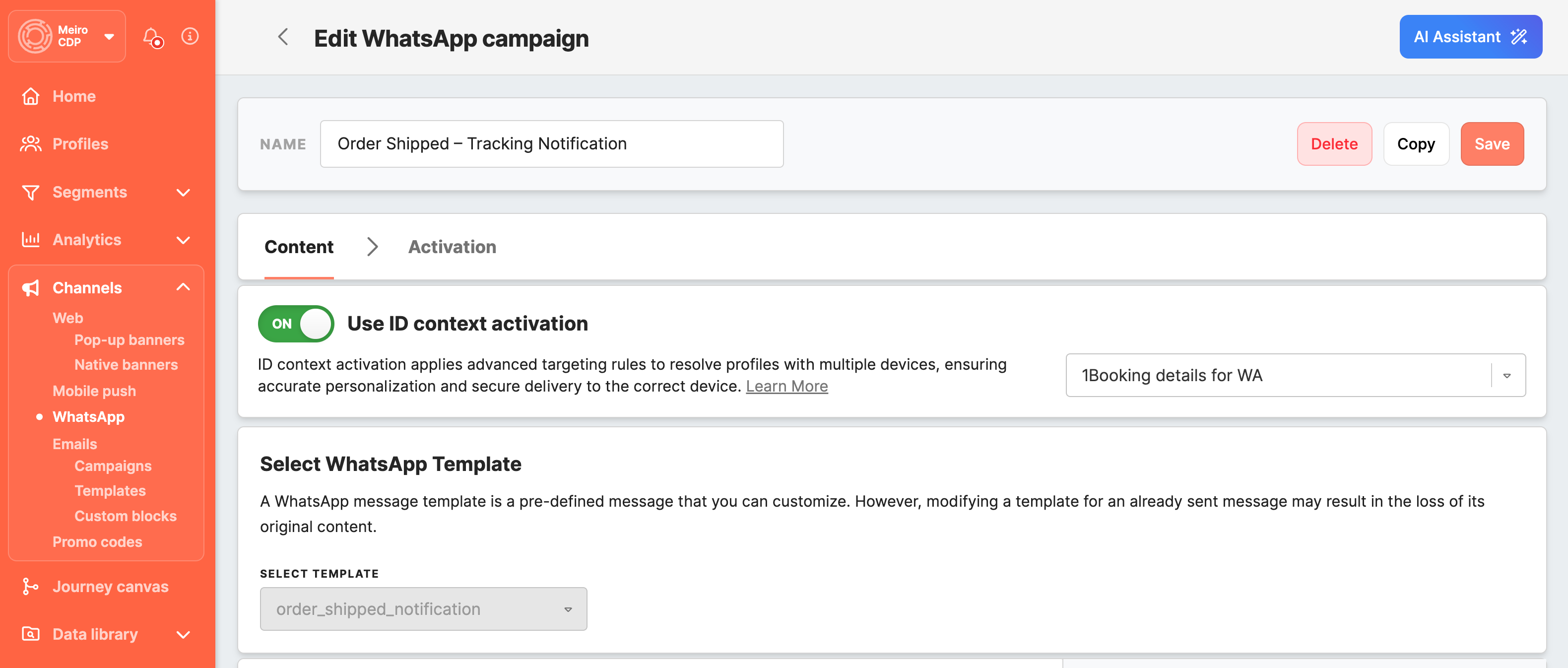
In this example, the campaign is treated as transactional based on the selected template, and ID context activation is enabled by selecting the appropriate ID context attribute.
Incomplete transactional configuration
You can create and edit a WhatsApp campaign based on a transactional template without selecting an ID context activation attribute. However, the campaign cannot be activated until this configuration is completed.
Example: transactional WhatsApp campaign without selected ID context attribute
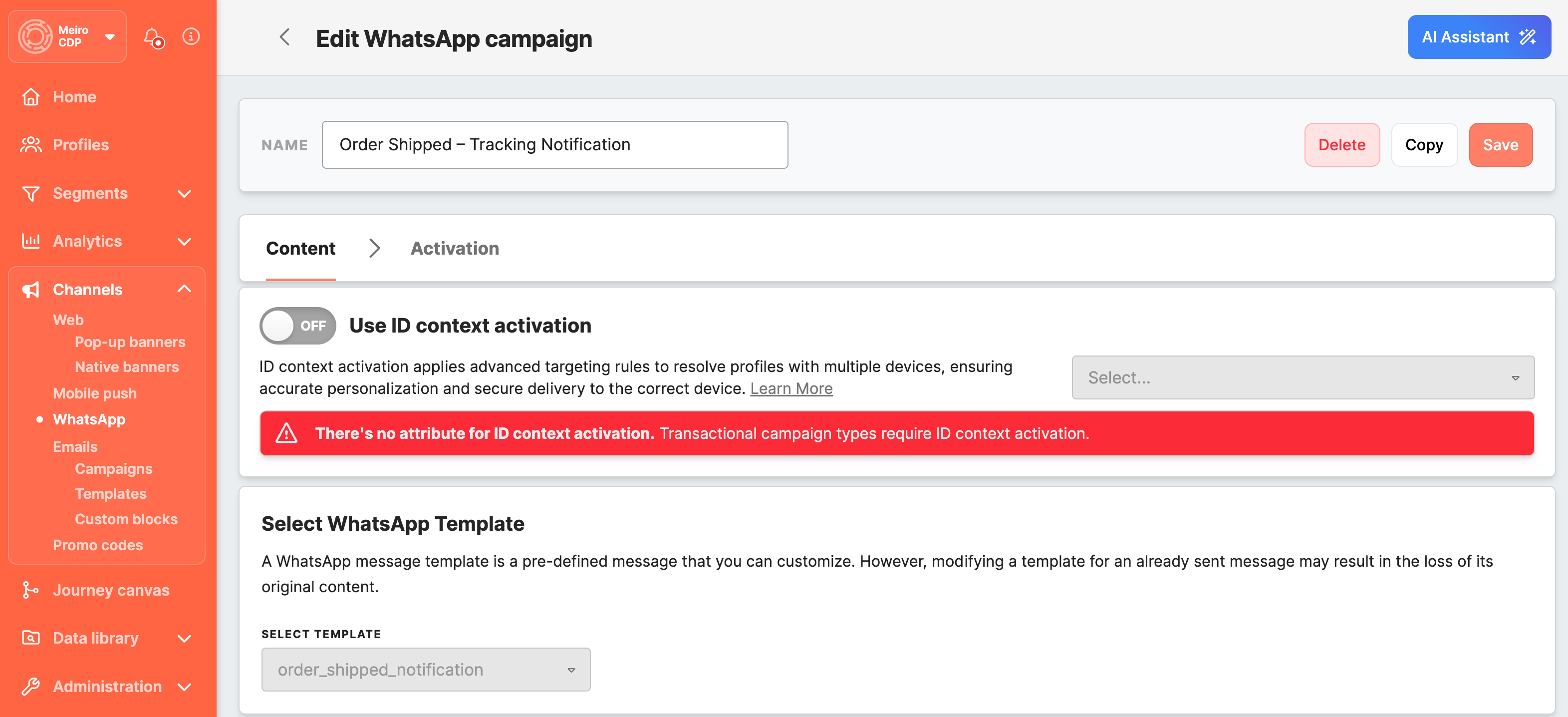
If Use ID context activation is not enabled, or no attribute is selected, you can still continue working on the campaign content. Before testing or sending the campaign, however, you must enable Use ID context activation and choose the attribute that contains the recipient’s phone number.
Learn more: ID Context Attributes or WhatsApp personalization with ID context attributes
How to choose the right template type
A simple way to decide is to ask what the WhatsApp message is meant to do.
- Use a template intended for Marketing communication if the message is designed to promote, engage, or encourage action.
- Use a template intended for Transactional communication if the message is designed to provide important information related to an order, request, account action, booking, delivery, verification, or other service event.
Learn more: WhatsApp campaign creation: step-by-step
No Comments